Live Local Music To Your Desktop (Nineup)
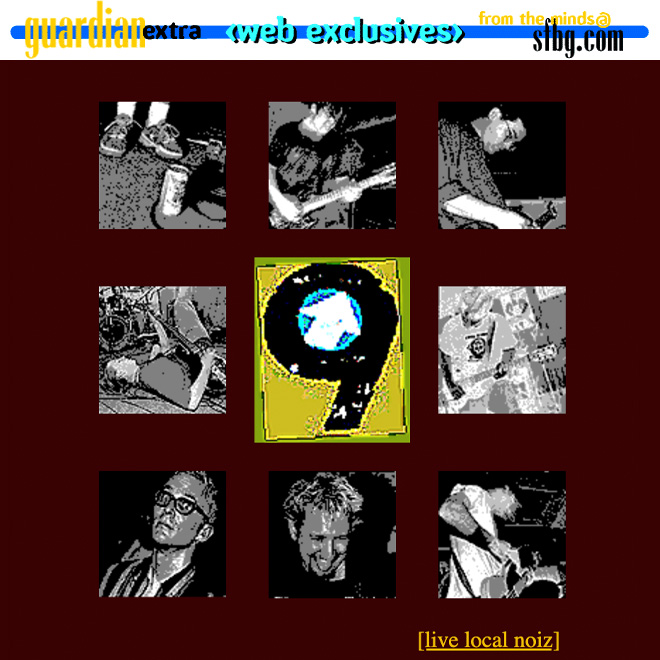
The SF Bay Guardian covers the groundbreaking work of Nineup streaming live performances of local San Francisco Bay Area bands. Chime’s Jon Luini and his MediaCast co-founder, Jon Fox, were part of the Nineup team.
Read the article below, or an archived copy here.
Bandwidth
nineup.com brings live local music out of the studio and onto your desktop
By Aimee Spanier
Hey, kids! You like that rock and roll music, but hate the idea of braving the crush of a smoky, humid nightclub? Want someone to hear your music, but can’t seem to break through the brick wall of the Bay Area club politics? What you need, then, is to head over to nineup.com.
Nineup is a bi-weekly live Internet broadcast of San Francisco bands performing in a rehearsal studio in the Bayview district. The show, sent across the airwaves every other Saturday, uses streaming audio and video, chats, photographs and live interviews to present to the Bay Area — and the world at large — local musicians of the region in a laid back atmosphere rife with improvisation, witty bon mots and Pabst Blue Ribbon. It’s the brainchild of a group of guys who are familiar with the club scramble, from the perspective of both audience and band. In October of 1996, Greg Bertens, Tim Mitchell, Ben Montasano, and Rich Ezekiel, all members of the band formerly known as Goldenrod (they’re in the process of picking a new name), and all working for various Internet-related companies, decided they wanted to do something about the bloated music scene. They put their heads together, and their Internet and musical experience, and came up with a plan.
“One of the problems with San Francisco is that there’s too many bands and not enough venues,” says Bertens. “Considering that, and the fact that the music scene here is so splintered, we thought it might be cool if we could create an event on-line and give people a sense of what’s going on in the City. Wouldn’t it be great if bands had another venue where they could put all bar politics aside, something that might give a little cohesion to the San Francisco sound?'”

The Fabulous Hedgehogs“We wanted a piece of the ‘net, something cooler than what was out there,” adds Mitchell. “We saw the downward trend of the current live music scene, and wanted to give bands another vehicle to play through and a way for people to understand what these bands have to offer. So we scraped some money together, bought some equipment and dropped an ISDN line into the studio.”
And so it began. Sort of.
Though the four of them had experience with audio production, Web design and band relations, they lacked Internet broadcasting know-how. They filled that gap with Jon Luini and Jon Fox, founders of MediaCast, a 2 1/2-year-old company known for its high-quality, easily-accessible netcasts. They brought in an “Audio Guru,” Brian Benitez, and a professional photographer, Marla Aufmuth. And on January 16 of this year they broadcast their first show, which featured their best-known band, the now-defunct Van Gogh’s Daughter. Since then, they’ve hosted over 40 groups, none of them quite as well known as the first.

WalrusOf course, a recognizable name doesn’t necessarily make for the best performance. In fact, considering the environment, it’s probably best if they avoid Big Rock Star Egos. Rehearsal room 9U is 15’x20′, hot, stuffy, and usually filled with wires, amps, and chain smokers with attitude. Though the Nineuppers provide refreshment, it’s limited to Pabst Blue Ribbon (“The bottom line is it’s the cheapest beer we can find, and we have to buy a lot of it”, explains Tim). There’s no dressing room and there’s definitely no money at the end of the day.
The trade-off is that the bands — and their audience — get a show put on by people who really care about what they’re doing, and about creating an entertaining and relaxed atmosphere for all involved. No one’s making a profit from this venture (with the possible exception of Pabst) and, though nobody would turn down a check, nobody’s obsessing about finding a sponsor to pay the bills and keep the project afloat. It’s a labor of love.

Hetch Hetchy“The most important part of planning for Nineup’s future is maintaining its integrity,” says Bertens.
Without a corporate sponsor, a club owner, or a cranky audience in their face, the band can let their hair down and have good, clean (well, maybe not so clean) fun.
“Normally, you’d think an Internet broadcast would be a stiff event, like filming a video. It’s not like that at all,” Mitchell says. “Bands come in and play, and it’s spontaneous. Wacky shit goes on. They don’t feel the press of having to wow the crowd. They don’t worry about angering the booking agent for not drawing enough people. All they’re required to do is set up and play.”
They’re certainly not required to play a particular kind of music. “That’s the beauty of it,” adds Mitchell. “I can’t think of any genre we’d ostracize because of our own tastes. Nineup is all about presenting what we see as a cross section of the San Francisco music scene. If we’re featuring a band we think is cheesy or egotistical, that’ll be apparent in how they’re presented on the site.” Band bios, interviews and teasers are all used to get the Nineup point across.
Despite the conceit of the site, Internet savvy isn’t a prerequisite for the performers or their audience. Band members are often seen after their sets getting a Web debriefing from Jon Luini, who also fields questions from users with technical difficulties. Sometimes bands will try and keep themselves in check, asking sheepishly, “Are we allowed to do that on the Internet?” The answer, in almost every case, is a resounding “Yes.”
“I think there’s some shit that goes on that is a little vulgar, a little immature…mostly immature,” says Mitchell. “For the 12-15 year old adolescent male, we’re a good source of information. That goes back to the spontaneity of the site. Whatever happens is broadcast to the Web. We start the tape and stop the tape. Whatever happens in between, you hear.”
They’re a small group, but they’re scrappy. And while there has been corporate interest in creating similar on-line venues, Nineup isn’t worried about being shoved out by the Big Boys.
“On a day to day basis, how often are you exposed to multinational conglomerates trying to be cool ? How often are they successful ?” asks Luini. “As hard as they might try, people in suits trying to be in touch with the underground scene will always be kept at a distance. They can’t bridge the gap. Companies like that need groups like Nineup to tap into local music scenes. It’s not a question of ‘we decided to do something, and we’ll just throw money at it.’ You have to be a part of the community.”
“Nineup’s achievement,” chimes in Bertens, “is pulling off the live broadcast. But it goes beyond the broadcast. We want to represent the local scene, and document it, with past archives, interviews and chats where people interested in the local scene can just talk freely.
“Anyway,” he adds, “Miller may put together a “Live from the Rehearsal Studio” thing, but they’ll never supply it with Pabst.”